Coach Hire for Groups Over 60: Fleet Combinations, Costs and Dispatch Planning
Compare coach combinations for 61–300 passengers, hourly and transfer totals, costs per seat, 45/60-seat layouts and luggage capacity. Includes six worked examples and multi-coach dispatch guidance.
Large-group transport guide
Coach hire for more than 60 passengers: key answers
Flying Eagle's largest single vehicle is a 60-seat coach, so groups over 60 need at least two vehicles. The basic fleet principle is: use 60-seat coaches as the core and 24/28 seats for the remainder. According to the Flying Eagle price list, urban 60-seat hire is $380/hour, about $6.3 per seat; a 28-seat coach costs $320/hour, about $11.4 per seat. The larger coach's per-seat cost is almost half.
For 75 people, 60 + 28 seats cost $700/hour in urban areas. For 110 people, two 60-seat coaches cost $760/hour, less than $1,020 for one 60-seat and two 28-seat coaches. Below are low-cost combinations for 61–300 passengers, per-seat comparisons, seating layouts and multi-coach dispatch methods.
Combination principles
- Use 60-seat coaches as the core
- Use 24/28 seats for a remainder of up to 28
- Add another 60-seat coach for a remainder above 28
Per-seat urban hourly costs
- 60 seats: about $6.3/seat/hour
- 45 seats: about $8.4/seat/hour
- 28 seats: about $11.4/seat/hour
Request a quotation
- Telephone: 2456 9339
- WhatsApp: 5922 9318
- Online enquiry form
Contents
- Four steps to combining vehicles
- Lowest-cost fleet combinations for 61–300 people
- Cost per seat: why larger coaches offer value
- One large coach or two small ones?
- Seating layouts and comfort
- Luggage and equipment: special planning for airport groups
- Six worked examples
- Multi-coach dispatch methods
- Passenger allocation principles
- When to book for large groups
- Common mistakes
- Frequently asked questions
Method
Four steps to planning a large-group fleet
Step 1: count the true total
Include all participants, group leaders, teachers, staff, photographers, hosts and accompanying family. Passenger numbers must not exceed approved seating capacity.
Step 2: decide seat occupancy
A 60-seat coach theoretically carries 60, but filling every seat depends on journey length and passenger type. Short student trips can use more capacity; for long adult or countryside journeys, allow around 10% spare seats for comfort and late additions.
Step 3: choose the lowest-cost combination
Divide the total by 60 for the core fleet. Add a 24/28-seat coach if the remainder is up to 28; above 28, another 60-seat coach is usually better value.
Step 4: check management and route access
Does every coach have a coordinator? Is allocation convenient for roll calls? Can large coaches stop at the pickup and destination? Narrow roads may require smaller vehicles.
For the basic differences between vehicles, see the guide to seating options from 16-seat minibuses to large coaches.
Fleet combinations
Lowest-cost fleet combinations for 61–300 people
These combinations use Flying Eagle's urban rates: 60 seats $380/hour, 24/28 seats $320/hour; urban Kowloon one-way rates are $700 and $500 respectively. Actual charges follow the quotation.
| Total passengers | Suggested combination | Total seats | Urban hourly total | Urban Kowloon one-way |
|---|---|---|---|---|
| 61–88 people | 60 seats + 28 seats | 88 | $700 | $1,200 |
| 89–120 people | Two 60-seat coaches | 120 | $760 | $1,400 |
| 121–148 people | Two 60-seat coaches + one 28-seat coach | 148 | $1,080 | $1,900 |
| 149–180 people | Three 60-seat coaches | 180 | $1,140 | $2,100 |
| 181–208 people | Three 60-seat coaches + one 28-seat coach | 208 | $1,460 | $2,600 |
| 209–240 people | Four 60-seat coaches | 240 | $1,520 | $2,800 |
| 241–268 people | Four 60-seat coaches + one 28-seat coach | 268 | $1,840 | $3,300 |
| 269–300 people | Five 60-seat coaches | 300 | $1,900 | $3,500 |
- Total seats are maximum capacity; allow around 10% spare seats for long adult journeys.
- Urban hire has a 4-hour minimum. More distant district rates are $450/hour for 60 seats and $350/hour for 28 seats, with an extra hour for use below 6 hours.
- Out-of-hours charges, tolls, parking and surcharges apply separately to each vehicle.
Why switch to two 60-seat coaches from 89 passengers?
For 89 people, one 60-seat plus two 28-seat coaches provides 116 seats at $1,020/hour. Two 60-seat coaches provide 120 seats for $760/hour: $260 less per hour and 4 more seats. This is a common large-group budgeting error.
Cost per seat
Cost per seat: why larger coaches offer value
Flying Eagle groups 24/28 seats in one rate band and 45/60 seats in another. Within each band, more seats mean a lower per-seat cost.
| Vehicle | Urban hourly hire | Per seat per hour | Urban Kowloon one-way | Per seat one-way |
|---|---|---|---|---|
| 24 seats | $320 | About $13.3 | $500 | About $20.8 |
| 28 seats | $320 | About $11.4 | $500 | About $17.9 |
| 45 seats | $380 | About $8.4 | $700 | About $15.6 |
| 60 seats | $380 | About $6.3 | $700 | About $11.7 |
This explains using 60-seat coaches as the core: two carry 120 people for $760/hour, while four 28-seat coaches already cost $1,280/hour and provide only 112 seats, still insufficient.
Big vs small
One large coach or two small ones?
Price is not the only factor. Compare one 60-seat coach with two 28-seat coaches for a group of around 60:
| Comparison | One 60-seat coach | Two 24/28-seat coaches |
|---|---|---|
| Urban hourly hire | $380/hour | $640/hour |
| Urban Kowloon one-way | $700 | $1,000 |
| Roll calls and management | One roll call with the whole group together | Two coordinators needed |
| Narrow and village roads | Access may not be possible | More flexible |
| Separate itineraries | Cannot split the group | Two groups can visit different places |
| Boarding time | One door; slower | Two vehicles boarding simultaneously; faster |
| Luggage compartment | Luggage compartment available | Less space |
When should you choose smaller coaches?
- The destination has village, campsite or estate roads inaccessible to large coaches.
- The group needs to split for different destinations.
- Return drop-offs require two separate district routes.
Otherwise, one large coach usually offers better value and simpler supervision.
Seating
Seating layouts and comfort
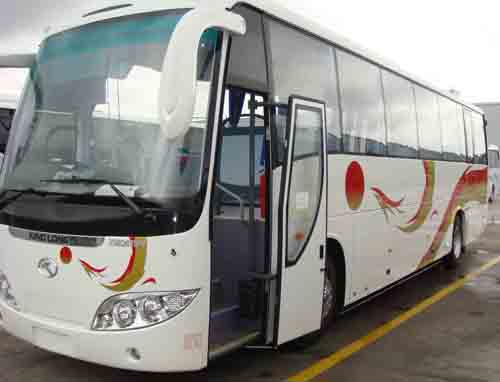
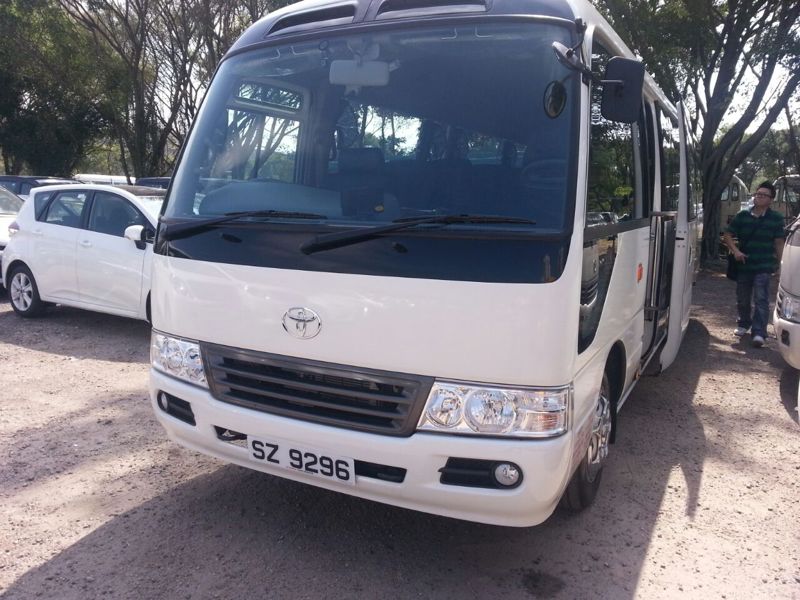
Large coaches commonly use 2+2 seating, four seats across an aisle, or 3+2 seating with five per row. Some 60-seat coaches use 3+2 layouts, providing more seats but narrower seats and aisles.
45 and 60 seats cost the same: which should you choose?
Since they share a price band, passenger needs are the key:
- Students and short journeys: 60 seats carry more people at the lowest per-seat cost.
- Adults on long or full-day journeys: If 60 seats are unnecessary, 45 seats may be more comfortable.
- Numbers approaching 45: Choose 60 seats for flexibility at the same listed rate.
Ask customer service about the actual vehicle's layout, or browse Fleet photos to see interiors.
Luggage
Luggage and equipment: special planning for airport groups
Most local events focus on seats, but luggage can reach capacity first for airport, cruise, campsite and study-tour groups. Large 45/60-seat coaches have luggage compartments; 24/28-seat coaches have less luggage space.
If everyone has a large suitcase, plan by luggage volume too. For 130 airport passengers, two 60-seat plus one 28-seat coach provide enough seats, but the smaller coach may not fit its passengers' suitcases. Three 60-seat coaches may be more suitable. Supply luggage quantities and dimensions for advice. See the airport coach transfer guide.
Examples
Large-group coach hire: six worked examples
These examples use the Flying Eagle price list for estimates only; actual charges follow the quotation.
Example 1: 75 people on a half-day urban event
60 + 28 seats for 4 hours: ($380 + $320) × 4 = $2,800, about $37 per person, plus tolls and parking.
Example 2: 110 people, one-way within urban Kowloon
Two 60-seat coaches: $700 × 2 = $1,400. One 60-seat plus two 28-seat coaches costs $700 + $500 × 2 = $1,700, or $300 more.
Example 3: a 150-person whole-year Sai Kung trip
150 exceeds 148 seats, so use three 60-seat coaches. At $950 each way from Kowloon: $950 × 3 × 2 = $5,700, or $38 per person.
Example 4: 200 wedding guests leaving a banquet
Three 60-seat plus one 28-seat coach for 4 urban hours: $1,460 × 4 = $5,840. After 22:00, add $100/$200 per vehicle. Estimated total: $6,240–$6,640.
Example 5: 130 passengers from urban Kowloon to the airport
By seats: two 60-seat coaches plus one 28-seat coach; $1,050 × 2 + $750 = $2,850. With more luggage, three 60-seat coaches cost $1,050 × 3 = $3,150: $300 more for greater luggage capacity.
Example 6: 68 adults on a full-day outing
60 + 28 seats provide 88 seats; 45 + 28 provide 73 at the same $700/hour, but the 45-seat layout may be roomier. Ask about both layouts before choosing for a full-day adult trip.
Dispatch
Multi-coach dispatch: keeping the group together
1. Number each coach
Use Coach 1, 2, 3 consistently in notices, lists and windscreen signs. Confirm registrations and driver contacts the day before departure.
2. Appoint a lead coordinator
One coordinator holds all registrations, driver numbers and routes. Other coordinators should contact that person first with issues.
3. Assign a coordinator to each coach
Use the same roll-call list for outward and return journeys; passengers must return on their assigned coach.
4. Stagger departures
Four or five coaches boarding together can block an entrance. Depart 3–5 minutes apart or use separate boarding points.
5. Agree one destination assembly point
Arrival times may differ. Designate a meeting point where early arrivals wait, preventing groups from dispersing.
6. Plan the return order
Dispatch the longest return route first, or sequence departures by district to minimise overall return time.
Grouping
Allocate by class, department or district?
| Allocation method | Suitable groups | Benefit |
|---|---|---|
| By class | School outings | Class teachers take roll calls with clear responsibility |
| By department | Company outings | Colleagues know one another, simplifying management |
| By return district | Dinners and event departures | Shorter return routes |
| By age or needs | Older adults and family groups | Allows roomier vehicles and a gentler pace |
For whole-year school outings, see the school trip coach guide; for company activities, the company outing coach guide; for post-event district drop-offs, the event coach transfer guide.
Timeline
When should large groups book?
Multiple vehicles on one day require early fleet availability checks. Demand peaks during school outing seasons, around public holidays, Christmas/New Year and popular wedding dates. Large groups should start earlier than usual, obtain a quotation with estimated numbers and confirm final counts after fixing the date. Report changes early to adjust combinations. Cancellations within 24 hours are non-refundable.
Common mistakes
6 common large-group coach mistakes
- Replacing large coaches with several small ones: Per-seat costs can be nearly twice as high.
- Using 60 + 28 + 28 for 89 people or more: Two 60-seat coaches cost less and provide more seats.
- Counting seats but not luggage: Especially important for airport and campsite groups.
- Filling every seat: No room for late additions and less comfort on long adult trips.
- All coaches boarding at the entrance together: Stagger timings or separate pickup points.
- No fixed return allocation: This can cause missed passengers or duplicate roll calls.
FAQ
Large-group coach hire FAQs
How many coaches are needed for 100 people?
Two 60-seat coaches provide 120 seats, at $760/hour for urban hire or $1,400 total for a one-way urban Kowloon trip.
What is the cheapest combination above 60 passengers?
Use 60-seat coaches as the core. Add 24/28 seats for a remainder up to 28, or another 60-seat coach above 28. For example, 61–88 use 60 + 28 seats; 89–120 use two 60-seat coaches.
Are coaches with 65 seats or more available?
Flying Eagle's largest single vehicle has 60 seats. Larger groups use several vehicles.
Do 45- and 60-seat coaches cost the same?
Yes. Both share a rate band: $380/hour for urban hire and $700 one-way within urban Kowloon.
How are surcharges calculated for multiple vehicles?
Out-of-hours charges, tolls, parking and surcharges apply separately to every vehicle.
How many coaches take 150 people to the airport?
Three 60-seat coaches provide 180 seats. From urban Kowloon to the airport, each costs $1,050 one-way, or $3,150 total. Large luggage compartments are preferable for substantial baggage.
Can several coaches depart together?
Yes, but stagger departures by 3–5 minutes or use different boarding points to avoid entrance congestion.
When should large groups book?
Enquire early for several vehicles on one date, especially during peak and holiday periods. Request a quotation with approximate numbers, then confirm final counts.
Request a large-group coach quotation
Send total passengers, luggage quantities, dates and itinerary. We will recommend suitable fleet combinations and prices.