School Trip Coach Hire
Choosing a 45- or 60-seat coach for a school trip? Compare fleet sizes, transfers and hourly hire, with urban 45/60-seat rates from $380 per hour, worked budgets, booking timelines and teacher checklists.
School trip transport guide
School trip coach hire: key answers first
Three things matter most when hiring a coach for a school trip: choose a vehicle for the actual passenger count, choose transfers or hourly hire to suit the itinerary, and send complete details early for a quotation. A 45-seat coach usually accommodates around 30 pupils and their teachers. For close to 50 passengers or more, consider a 60-seat coach or split classes between two vehicles. According to the Flying Eagle price list, urban hourly hire for 45/60-seat coaches is $380 per hour (minimum 4 hours), a one-way trip within urban Kowloon is $700, and urban 24/28-seat hourly hire is $320 per hour.
Written for teachers and activity organisers, this guide covers school outings, outdoor learning, visits, sports days and graduation activities. It explains passenger counts, fleet combinations, worked budgets, booking timelines, quotation details, roll calls and safety responsibilities to help with budget applications and activity plans.
Suggested vehicles
- Small groups / half a kindergarten class: 24/28 seats
- One class with teachers: 45 seats
- One large class or two small classes: 60 seats
Indicative prices
- Urban 45/60-seat hourly hire: from $380/hour
- Urban 24/28-seat hourly hire: from $320/hour
- Minimum 4 hours in urban areas; 5 hours in some districts
Booking enquiries
- Telephone: 2456 9339
- WhatsApp: 5922 9318
- Online enquiry form
Contents
- How many seats does a school trip need?
- Point-to-point transfers or hourly charter?
- School trip coach prices and worked examples
- Popular school trip destinations and district rates
- School trip booking timeline
- What to prepare for a quotation
- On the day: assembly, roll calls and boarding
- Teachers' responsibilities and conduct on board
- Different needs across kindergarten, primary, secondary and tertiary education
- Common school coach booking mistakes
- School trip coach hire FAQs
Seats
How many seats? Counting passengers and choosing a coach
Schools sometimes count only pupils and discover a shortage of seats on departure day. The total must include pupils, class teachers, accompanying teachers, teaching assistants, social workers, parent volunteers, photographers and other staff. Include any parents accompanying individual pupils too. Passenger numbers must not exceed the vehicle's approved seating capacity, and every passenger should have a seat.
Equipment also affects vehicle choice. Tell the operator in advance about first-aid kits, games equipment, sports gear, instruments, lunch boxes or large display boards. Large 45- and 60-seat coaches have luggage compartments and are better suited to equipment-heavy activities; smaller coaches suit small groups with simple itineraries.
| Activity size | Total passengers, including teachers | Suggested vehicles | Notes |
|---|---|---|---|
| Small groups, school teams and clubs | Around 10–16 people | 16-seat minibus | Enquire for local rates |
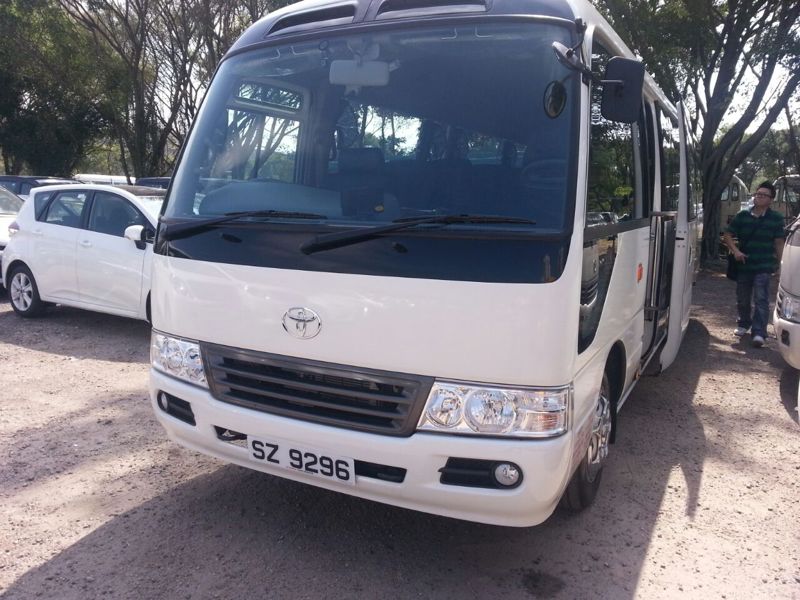
| Half a kindergarten class or a small class visit | Around 17–28 people | 24/28-seat coach | 24 and 28 seats share the same rate |
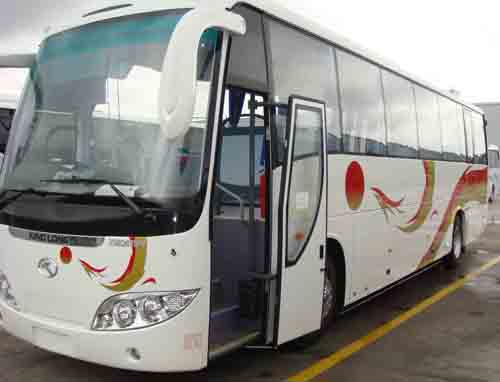
| One class outing | Around 29–45 people | 45-seat coach | Luggage compartment for equipment |
| One large class or two small classes | Around 46–60 people | 60-seat coach | 45 and 60 seats share the same rate |
| Whole-year outing | More than 60 people | Multiple 45/60-seat coaches, possibly with 24/28-seat coaches | Allocating coaches by class simplifies roll calls |
- The Flying Eagle price list places 24- and 28-seat coaches in one price band, and 45- and 60-seat coaches in another.
- Near capacity, choosing the larger vehicle within the same band gives more room at the same listed rate.
Why choose more seats when numbers approach capacity?
A class of 38 pupils and 4 teachers totals 42 people, leaving only 3 spare seats on a 45-seat coach. Another parent volunteer or bulky equipment could make arrangements tight. Since 45- and 60-seat coaches share a price band, a 60-seat coach offers more seating flexibility and comfort without a higher listed fare.
Whole-year outings: one large coach or several vehicles?
Whole-year outings usually need several coaches. The simplest arrangement is to allocate vehicles by class, with each class teacher taking the roll call and pupils returning on the same numbered coach. If numbers do not fill several large coaches, a combination such as 60 + 60 + 24/28 seats avoids hiring another large coach for a small remainder. For vehicle comparisons, see the guide to seating options from 16-seat minibuses to large coaches.
Booking mode
School trips: point-to-point transfers or hourly charter?
School trips commonly use two booking types: one-way point-to-point transfers and hourly charter. Neither is always better; the choice depends on whether the coach needs to remain with the group throughout the trip.
| Comparison | Transfers: outward and return legs | hourly charter |
|---|---|---|
| Suitable itinerary | School to one campsite or park, with no vehicle needed during activities | Several destinations in a day, or a vehicle needed on standby |
| Charging basis | Fixed district rate per journey | Hourly rate; minimum 4 hours in urban areas |
| Tunnel tolls | Cross-Harbour Tunnel and bridge tolls included; Eastern, Western or Tai Lam Tunnel routes cost extra | Tunnel tolls and parking charged separately |
| Flexibility | Agree the return time in advance | Adjust to progress on the day |
| Additional stops | Unsuitable for multiple pickup and drop-off points | $100 per additional en-route stop |
When are transfers better value?
If pupils stay at one destination for five to six hours, such as a campsite, country park or activity venue, and do not need a coach on standby, separate outward and return transfers usually cost less than all-day hourly hire. The driver does not have to wait throughout the day. Worked comparisons follow below.
When should you choose hourly hire?
Outdoor learning, study visits and city tours often involve two or three locations: a morning visit, lunch elsewhere and a third stop in the afternoon. Arranging each journey separately can be complicated. Hourly charter keeps the coach with the group and allows teachers to adjust timings to pupils' progress. For a detailed comparison of one-way, return and hourly bookings, see the coach booking process and quotation guide.
Price
School trip coach prices and worked examples
All prices below are taken from the Flying Eagle price list and are for budgeting only; the quotation determines the actual charge. Schools should allow for tunnel tolls, parking and possible out-of-hours surcharges in activity budgets.
| Hourly charging basis | 24/28 seats | 45/60 seats |
|---|---|---|
| Minimum 4 hours: urban areas, Lei Yue Mun, Tseung Kwan O, Kwai Chung, Tsing Yi, Tsuen Wan, Chai Wan and Aberdeen | $320/hour | $380/hour |
| Minimum 5 hours: The Peak, Tai Tam, Southern District, Stanley, Shek O and Repulse Bay | $350/hour | $450/hour |
| Airport, Lok Ma Chau, Sai Kung, Tai Po, Fanling, Sheung Shui, Tin Shui Wai, Yuen Long and Tuen MunAn extra 1-hour charge applies to hire of less than 6 hours | $350/hour | $450/hour |
- 28/45/60 seats: journeys before 08:30 or after 22:00 incur an out-of-hours surcharge of $100/$200 per trip.
- Tunnel tolls and parking are extra; each additional en-route stop costs $100.
- Waiting is limited to 15 minutes; exceeding this is charged as 1 hour.
- Cancellations within 24 hours are non-refundable.
Example 1: a half-day urban class visit, 45 seats for 4 hours
32 pupils and 3 teachers total 35 passengers. A 45-seat coach takes them to a Kowloon museum and back to school. Urban 45/60-seat hire is $380 per hour, minimum 4 hours: $380 × 4 = $1,520. Tunnel tolls and parking depend on the actual route and are extra.
Example 2: kindergarten family outing, 28 seats for 4 hours
A kindergarten group of 26 children, parents and teachers visits an urban park for half a day. Urban 24/28-seat hire costs $320 per hour: $320 × 4 = $1,280. A larger group could use a 45-seat coach, at $1,520 for 4 urban hours.
Example 3: a full-day Sai Kung outing, transfers versus hourly hire
A class travels from a Kowloon school to Sai Kung and returns after around 5 hours at a campsite. With one-way transfers, the listed Kowloon–Sai Kung 45/60-seat rate is $950 each way: $950 × 2 = $1,900 (add $50 per trip for Tai Mong Tsai or Pak Tam Chung).
With hourly hire, Sai Kung falls in the more distant district band, at $450 per hour for 45/60 seats. Assuming 7 hours including travel: $450 × 7 = $3,150, plus tunnel tolls and parking. Separate transfers are clearly better value when the coach is not needed during activities; hourly hire is more convenient when changing locations during the day.
Example 4: 132 passengers on a full-day Tuen Mun outing
Four classes total 120 pupils plus 12 teachers: 132 passengers. Two 60-seat coaches and one 28-seat coach provide 148 seats. For 6 hours in Tuen Mun, a more distant district: two 60-seat coaches at $450/hour total $900/hour, plus $350/hour for the 28-seat coach, giving $1,250/hour. For 6 hours: $1,250 × 6 = $7,500. Hiring for a full 6 hours avoids the extra 1-hour charge applicable to bookings of less than 6 hours.
Example 5: early departure surcharge
For departures before 08:30, hourly 28/45/60-seat services incur an extra $100 or $200 per trip. If Example 1 departs at 08:00, budget $1,520 plus the surcharge. Many schools assemble at 08:15 and depart after 08:30 to avoid this period, subject to their activity timetable.
Destinations
Popular school trip destinations and coach district rates
Coach prices vary by destination. These price-list district bands cover common school outing areas to help estimate your budget.
Sai Kung, Clear Water Bay and Kowloon Peak
Popular for countryside activities, campsites and beaches. One-way from Kowloon: 45/60 seats $950; 24/28 seats $700. Tai Mong Tsai or Pak Tam Chung adds $50 per trip. Hourly hire uses the more distant district band, with an extra 1-hour charge for less than 6 hours.
Tai Mo Shan, Yuen Long and Tuen Mun
Suitable for nature education and field trips. One-way from Kowloon: 45/60 seats $950; Lung Kwu Tan in Tuen Mun adds $100 per trip. Yuen Long and Tuen Mun hourly 45/60-seat hire is $450/hour.
Ma On Shan, Wu Kai Sha and Tai Po
Common locations for holiday camps and outdoor activities. One-way from Kowloon: 45/60 seats $850; 24/28 seats $650.
Sha Tin, Tsuen Wan, Kwai Chung and Tseung Kwan O
Common for sports days and visits. One-way from Kowloon: 45/60 seats $750; 24/28 seats $550. Tao Fong Shan in Sha Tin adds $100 per trip.
Southern Hong Kong Island: Stanley, Repulse Bay and The Peak
City tours and waterfront activities. Hourly hire has a 5-hour minimum, at $450/hour for 45/60 seats. One-way trips to The Peak and Southern District add $50 per journey.
Tin Shui Wai, Lok Ma Chau and Mai Po
Common wetland ecology destinations. One-way from Kowloon: 45/60 seats $1,000; 24/28 seats $750.
For all district rates, see the full price list. If your destination is not listed, send its address for an enquiry. For school exchanges in mainland China, consider the 45/49-seat cross-border coaches in our Hong Kong–mainland vehicle hire service.
Timeline
School trip booking timeline: when should you start?
School outings often fall in the same period, and demand rises around public holidays and after examinations. Enquire early to reserve a suitable vehicle. Schools can use this suggested timeline:
- 6–8 weeks before: Set the date, destination and approximate numbers, and request an initial quotation for the budget application.
- 4 weeks before: Confirm vehicle types and quantities, pickup location, departure and return times, and the booking.
- 2 weeks before: Check final passenger numbers and notify the operator early if a different vehicle is needed.
- 1 week before: Confirm driver contact details, pickup point and coach number or registration; issue notices to pupils and parents.
- 1 day before: Reconfirm assembly time and weather arrangements. Cancellations within 24 hours are non-refundable.
What if bad weather forces cancellation or rescheduling?
School trips are weather-sensitive. Ask about rescheduling arrangements and the final decision deadline when confirming the booking. As cancellations within 24 hours are non-refundable, set a go/no-go decision time in the activity plan and contact the operator before it.
Checklist
School trip quotation checklist
Complete information improves quotation accuracy and helps avoid unexpected charges on the day. Teachers should prepare the following together and submit them by telephone, WhatsApp, email or the Online enquiry form.
Date and time
Activity date, assembly and departure times, expected return time and a backup date if applicable.
Passengers and vehicles
Pupil, teacher and staff counts, whether parents are joining, and preferred vehicle types.
Pickup and drop-off points
School address, coach stopping point inside or outside the school, destination address and intermediate stops.
Booking type
Separate outward/return transfers or hourly charter throughout; whether the coach must wait during activities.
Equipment and special requirements
List luggage, equipment, instruments, wheelchairs and other requirements in advance for planning.
Payment and paperwork
Payment method, quotation or receipt addressee, and documents required by the school's procurement process.
School payment options
Flying Eagle accepts cash in Hong Kong dollars or renminbi, cheques, bank transfers, PayMe, FPS, WeChat Pay and Alipay. Institutional customers can apply for monthly billing. Mention any required quotation or invoice format when enquiring.
On the day
On the day: assembly, roll calls and boarding arrangements
Assembly and boarding, rather than the journey itself, often cause difficulties. Coach waiting time is limited to 15 minutes; exceeding this is charged as 1 hour, so allow a buffer.
1. Separate assembly time from departure time
State an assembly time 15–20 minutes before departure in the notice. For an 08:45 departure, pupils could arrive at 08:25, allowing teachers 15 minutes for roll calls and grouping before boarding. This reduces the risk of a few late arrivals extending coach waiting time.
2. Confirm where the coach can stop
Access to school grounds depends on approval, gate height, road width and turning space. For roadside pickup, choose a safe, convenient boarding point and have teachers supervise, avoiding pupils waiting beside traffic. Tell the operator the stopping location when booking.
3. Board and take roll calls by class
For multiple coaches, display a class or vehicle number on each. Pupils board according to a list and teachers repeat the roll call on board. Using the same coach for the return helps prevent confusion and omissions.
4. During the journey and on arrival
Remind pupils to remain seated, avoid walking around and fasten seat belts where fitted. A teacher should get off first to check the surroundings, then supervise orderly disembarking and remind pupils to take their belongings.
5. Return journey
Allow time for a return roll call too. Notify the driver early if activities run late. Hourly services can be charged for actual time; contact customer service promptly to rearrange a changed one-way return time.
Safety
Teachers' responsibilities and conduct on board
Clear responsibilities make school transport smoother. Schools can adapt these common roles to available staffing:
| Role | Main duties |
|---|---|
| Lead teacher | Liaise with the operator and drivers; oversee every vehicle's timetable |
| Teacher in charge of each coach | Take roll calls, supervise conduct, record coach numbers and driver contacts |
| First-aid lead | Carry first-aid supplies and monitor travel sickness or unwell pupils |
| Equipment lead | Organise luggage-compartment loading and unloading; check nothing is left on return |
Pupils prone to travel sickness
Seat pupils who are prone to travel sickness near the front and ask parents to prepare in advance. Rural roads can be winding; remind pupils not to spend too long reading or using screens on board.
Keeping the coach clean
Encourage pupils to drink only water and avoid foods that stain seats. A teacher should inspect the coach before leaving and collect rubbish and forgotten belongings.
School levels
Different coach needs across education levels
Kindergarten: family outings and small-class visits
Parents often join kindergarten outings and must be included in the count. Short, half-day trips are preferable, commonly using 24/28- or 45-seat coaches. Boarding takes longer, so allow plenty of assembly time.
Primary: whole-year outings and outdoor learning
Whole-year primary outings usually require several 45/60-seat coaches. Allocation by class is easiest to manage. Consider hourly charter for outdoor learning days with several destinations.
Secondary: field trips, sports days and graduation activities
Secondary activities include geography fieldwork, sports days, inter-school competitions and graduation trips. Sports days commonly use two one-way transfers, while field trips more often use hourly hire. Smaller school teams can choose a 16-seat minibus or 24/28-seat coach.
Tertiary: orientation camps and exchanges
Orientation camps and society activities often use holiday camps and carry substantial equipment. A large coach with a luggage compartment is recommended. For mainland exchanges, see the complete Hong Kong–mainland charter guide.
Common mistakes
5 common school coach booking mistakes
- Counting only pupils: Forgetting teachers, assistants and parents can leave too few seats.
- Making assembly and departure times identical: Roll calls can extend waiting beyond 15 minutes, triggering a 1-hour charge.
- Hiring all day when no coach is needed between transfers: Two separate transfers may cost less if the vehicle need not remain on standby.
- Omitting tolls and parking from the budget: These are extra for hourly services and should be included in budget applications.
- Cancelling or rescheduling too late: Cancellations within 24 hours are non-refundable; set the decision deadline in advance.
FAQ
School trip coach hire FAQs
What size coach does one class need?
A 45-seat coach generally accommodates around 30 pupils and their teachers. If the total approaches 45, consider 60 seats: 45- and 60-seat coaches share a price band in Flying Eagle's price list.
How much does a school trip coach cost?
Urban 45/60-seat hire is $380/hour, minimum 4 hours, or around $1,520 for half a day. One-way urban Kowloon transfers cost $700. In more distant areas such as Sai Kung and Tuen Mun, 45/60-seat hourly hire is $450/hour. Actual charges depend on the quotation.
Are transfers or hourly hire better for school outings?
Separate outward and return transfers are usually better value when staying at one venue all day. Hourly charter is more convenient for multiple destinations or standby requirements.
How long can the coach wait for pupils?
Waiting is limited to 15 minutes; exceeding this is charged as 1 hour. Assemble 15–20 minutes before departure.
Is there a surcharge for departure before 8 am?
Yes. Hourly services before 08:30 or after 22:00 incur an extra $100 or $200 per trip for 28/45/60-seat vehicles.
When should a school book its coach?
Enquire 6–8 weeks before the activity and confirm around 4 weeks ahead. School trip seasons and holiday periods are busier, so enquire early.
Is a school trip cancelled because of rain refundable?
Flying Eagle's cancellation terms provide no refund within 24 hours. Set a decision time in the activity plan and ask customer service about rescheduling when confirming.
How can schools pay?
Cash, cheque, bank transfer, PayMe, FPS, WeChat Pay and Alipay are accepted. Institutional customers can apply for monthly billing.
Request a school trip coach quotation
Send the date, passenger count, pickup point and destination. We will suggest suitable vehicles and quote for your itinerary.