Staff and Residential Shuttle Buses: Routes, Capacity and Contract Planning
Planning a staff or residential shuttle? Learn how to assess demand, design stops and timetables, calculate capacity, compare contract pricing, check Transport Department endorsements and run a trial, with worked examples.
Long-term bus hire guide
Staff and residential shuttles: key answers first
For businesses in industrial or warehouse areas, or far from an MTR station, and housing estates some distance from a transport hub, a shuttle buscan make daily travel much easier. Unlike one-off coach hire, shuttle services run at fixed times and stops over a longer period, usually on a monthly or contract basis rather than separate one-way or hourly bookings.
Planning a shuttle route centres on three questions: How many people use the busiest departure?, How long does one vehicle take to complete a round trip?, How many vehicles are needed to carry everyone during the peak period?These determine vehicle sizes, fleet numbers and quotations. Long-term fixed routes may require Transport Department service endorsements; confirm compliance arrangements with the operator before launch.
Suitable users
- Businesses, factories, warehouses and construction sites
- Private housing estates and clubhouses
- Shopping centres, events and short-term shuttles
Hire arrangement
- Monthly or contract basis
- Hourly hire can support a trial
- Corporate customers can apply for monthly billing
Request a quotation
- Telephone: 2456 9339
- WhatsApp: 5922 9318
- Online enquiry form
Contents
- Shuttles versus one-off coach hire
- Common shuttle service types
- Licences and endorsements to check before launch
- Six steps to planning a shuttle route
- Fleet capacity formulas and examples
- Choosing shuttle vehicles
- Shuttle pricing and quotation factors
- Contract checklist
- Residential shuttles: guidance for management and owners' committees
- Trials and reviews
- Common mistakes
- Frequently asked questions
Comparison
How do shuttles differ from one-off coach hire?
First-time enquiries often use an event-hire model, such as hiring a coach for two hours every day. However, long-term shuttle planning, pricing and contracts differ considerably from company outings or wedding transport.
| Comparison | One-off coach hire | Shuttle service |
|---|---|---|
| Frequency of use | One or several days | Every working day or every day |
| Route | Depends on the event | Fixed stops and timetable |
| Charging basis | One-way or hourly | Monthly or contract |
| Planning focus | Passenger numbers and destination | Peak capacity, round-trip time and frequency |
| Compliance considerations | General hire arrangements | Long-term fixed routes may require Transport Department approval |
| Payment | Per booking | Monthly billing available on application |
For transport on a single event day, such as a company outing or annual dinner departure, see the company outing coach guide; for school activities, see the school trip coach guide.
Types
Common shuttle service types
Staff commuting shuttles
Links between MTR stations or bus terminals and offices are common in industrial and technology parks or outside commercial centres. Departures concentrate on morning and evening commuting periods.
Factory, warehouse and logistics centre transport
Services must match early, middle and night shifts. Some departures may be very early or late, requiring particular attention to driver arrangements and time-based charges.
Construction site transport
Remote sites and workers carrying tools favour vehicles with luggage compartments. A project's defined start and end dates suit a contract covering its duration.
Residential shuttle buses
Management offices or owners' committees arrange links from estates to MTR stations, commercial areas or town centres, usually covering the main travel periods throughout the day.
Clubhouse, shopping centre and property-viewing shuttles
Connections for members, shoppers or property viewers may focus on weekends or particular hours.
Short-term event shuttles
Hotel–venue transfers during exhibitions, large events or multi-day conferences can be quoted by service days and hours.
Licensing
Licences and endorsements to check before launch
Hong Kong non-franchised buses, including coaches, operate under Transport Department passenger service licences and relevant service endorsements. Shuttle uses fall into different categories, including employees' services, residents' services and contract hire services. Long-term repeated services between the same locations generally require prior approval, rather than simply hiring a coach every day.
| Service category | Typical use | Questions when planning |
|---|---|---|
| Employees' service | Staff commuting | Do the route and timetable require approval? |
| Residents' service | Estate–transport hub connections | How are service details, stops and frequency approved? |
| Contract hire service | Temporary or short-term transfers, such as events and banquets | Does repeated operation between the same endpoints exceed the permitted duration? |
Why resolve compliance before launching?
Missing endorsements may later require route changes or suspension, disrupting staff and residents. Insurance, responsibilities and route changes also relate to the service category. Ask which category applies, whether approval is needed, how long it takes and who submits information when requesting quotations. Refer to the Transport Department's latest rules for exact requirements.
Planning
Six steps to planning a shuttle route
Step 1: survey demand, not just the staff list
A company with 200 staff does not necessarily have 200 daily passengers. Survey home districts, preferred MTR interchange, work times and whether staff would use a shuttle every day. Estate management can survey residents' main destinations and travel times.
Step 2: choose stops
Fewer stops mean faster, more punctual journeys. Typically connect an MTR station or major hub directly to the workplace or estate. Check safe coach access, lawful boarding and space for waiting passengers. Obtain owner or management permission for stops on private roads or estate grounds.
Step 3: work backwards from the required arrival time
For a 09:00 work start, the last bus should arrive by 08:45. Work backwards using journey time, peak congestion, tunnels and dwell time at each stop to set departures.
Step 4: calculate fleet capacity
Use peak passenger demand and round-trip time to calculate vehicle quantities and seating capacity. Detailed formulas follow below.
Step 5: confirm vehicles and compliance
Choose vehicles based on passenger numbers, road conditions at stops and carried items. Confirm service endorsements and application arrangements with the operator.
Step 6: trial and review
Run a trial before the full launch, recording actual boarding numbers at every stop and departure, then adjust frequency and vehicles.
Capacity
Shuttle fleet capacity formulas and examples
The key to fleet size is not the whole-day total but the number of passengers in the busiest hour. Estimate it as follows:
1. Round-trip time
Outward travel + return travel + boarding/alighting + buffer.
2. Departures per vehicle per hour
60 minutes ÷ round-trip time.
3. Passengers per vehicle per hour
Seats × departures per hour.
4. Vehicles required
Peak-hour passengers ÷ capacity per vehicle per hour, rounded up.
Example 1: morning factory staff transport
Around 150 staff travel from an MTR station between 08:00 and 09:00. The outward journey takes 15 minutes, the empty return 12 minutes, and boarding plus buffer 8 minutes: a 35-minute round trip.
- Departures per vehicle per hour: 60 ÷ 35 ≈ 1.7; using 1.5 for practical scheduling is more cautious.
- One 60-seat coach's hourly capacity: 60 × 1.5 = 90 passengers.
- Vehicles required: 150 ÷ 90 ≈ 1.7, meaning two 60-seat coaches.
With 45 seats, hourly capacity is around 67 per vehicle: 150 ÷ 67 ≈ 2.2, requiring three 45-seat coaches. As 45- and 60-seat coaches share a Flying Eagle price band, two 60-seat vehicles are usually better value in this example.
Example 2: morning estate-to-MTR shuttle
Around 80 residents travel between 07:30 and 08:30. The MTR journey is 10 minutes, with a 25-minute round trip including boarding, or 2.4 departures per hour. A 28-seat coach carries around 28 × 2.4 ≈ 67 people, insufficient for 80. A 45-seat coach carries around 45 × 2.4 ≈ 108, enough with departures every 25 minutes. For greater frequency, two alternating 28-seat coaches could run every 12–13 minutes.
Why allow a buffer?
Rush-hour congestion is common, especially near tunnel entrances and MTR stations. A 20%–30% time buffer improves punctuality and reduces staff concerns about arriving late.
Fleet
Choosing shuttle vehicles
| Vehicle | Best suited to | Points to check |
|---|---|---|
| 16-seat minibus | Small groups, frequent departures, narrow roads or estate access | Smaller body for easier access |
| 24/28-seat coach | Small and medium businesses; off-peak estate services | 24 and 28 seats share a price band |
| 45-seat coach | Peak periods or staff carrying items | Luggage compartment available |
| 60-seat coach | Large factories, logistics centres and estates | Confirm stops can accommodate large vehicles |
Different vehicles for peak and off-peak periods
If morning demand is high but daytime use is low, consider large coaches at peak times and smaller vehicles off-peak to avoid unnecessary all-day capacity. Specify this clearly in the contract.
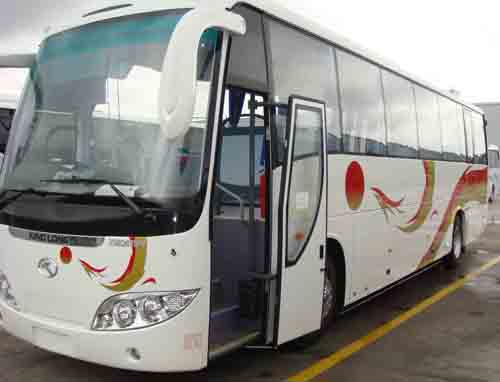
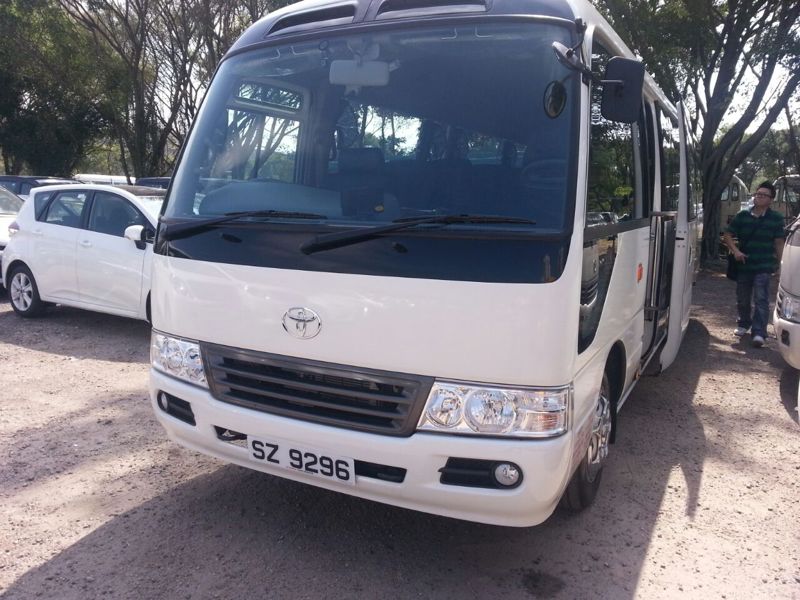
For more vehicle information, see the coach hire vehicle overview and coach seating guide.
Price
Shuttle pricing and quotation factors
Long-term shuttle prices are tailored to routes, frequency and service days rather than copied from one-off hire rates. Flying Eagle offers monthly or contract shuttles for businesses, factories, construction sites, estates and clubhouses. Corporate customers can apply for monthly billing.
Main quotation factors
| Factor | Effect |
|---|---|
| Vehicle sizes and quantities | More seats and vehicles increase costs |
| Daily service hours | Morning/evening periods only or all-day service |
| Number of departures | Daily departures and intervals |
| Route distance and tunnels | Tunnel use and route length affect costs |
| Service days | Monday–Friday, including Saturdays, or every day year-round |
| Time of day | Early-morning or late-night services may require extra arrangements |
| Contract duration | Contract length affects overall arrangements |
Use hourly hire as a trial budget reference
For a one- or two-week trial before a long-term contract, hourly rates provide a reference. According to the Flying Eagle price list, urban 24/28-seat hire is $320/hour and 45/60 seats $380/hour, minimum 4 hours. For more distant areas such as the airport, Sai Kung, Tai Po, Tuen Mun and Yuen Long, 45/60 seats cost $450/hour with an extra 1-hour charge for less than 6 hours. Before 08:30 or after 22:00, 28/45/60 seats incur $100/$200 extra per trip.
For example, one 60-seat coach for a 4-hour urban morning trial costs $380 × 4 = $1,520, plus tolls and parking. Starting before 08:30 adds an out-of-hours surcharge. Trial data helps set long-term timetables and contract quotations.
Contract
Shuttle contract checklist
Long-term agreements involve more detail. Confirm each item before signing to reduce disputes:
Service scope
Route, stops, timetable and operating days, including public holidays.
Contract duration
Start/end dates, renewal method and termination notice.
Changes
Notice periods and charges for changing frequency, adding vehicles or altering stops.
Severe weather
Suspension, resumption and charging arrangements during typhoons or heavy rain.
Replacement vehicles
Cover for vehicle maintenance or driver leave, and notification arrangements.
Payment and settlement
Monthly billing date, payment methods and invoice/receipt formats.
Communication
Regular contacts on both sides, emergency contacts and issue-reporting channels.
Compliance and insurance
Service endorsement category, insurance and responsibilities.
Residential
Residential shuttles: guidance for management and owners' committees
Understand residents' actual needs first
Estate users include workers, students, older residents and homemakers with different travel times. Ask about main destinations, travel periods, weekly frequency and weekend needs.
Stops and parking within the estate
Consider road width, turning space, distance from residential lobbies and pedestrian safety. Narrow estate roads may suit 16-seat minibuses or 24/28-seat coaches.
Fares and operating model
Management or owners' committees hire the service. Whether residents pay and how fares are collected affects the service category and compliance requirements. Discuss these early with the operator.
Older residents and special requirements
For estates with many older residents, boarding height, handrails and reliable timetables matter. Explain wheelchair or other requirements in advance to confirm whether they can be accommodated.
Review
Shuttle trials and review methods
Actual demand often differs from survey results. Review regularly during the first one or two months:
- Record every departure: Boardings at each stop, arrival times and reasons for delays.
- Identify the busiest departure: If regularly full, add departures or use a larger vehicle.
- Reduce persistently underused departures: Consider combining services carrying only a few passengers.
- Collect feedback: Use internal channels or estate management to gather passenger views.
- Review with the operator: Adjust frequency, stops and vehicle sizes using the data, then update the contract.
Common mistakes
6 common shuttle planning mistakes
- Using total staff numbers: Calculate actual peak-period ridership instead.
- Too many stops: Each stop slows the service and affects punctuality.
- No congestion buffer: Rush-hour journeys can take much longer than normal.
- Overlooking compliance: Long-term fixed routes may require Transport Department approval; confirm before launch.
- Omitting severe-weather and holiday terms: This can cause disputes.
- No review after launch: Demand changes, so timetables must adapt.
FAQ
Staff and residential shuttle FAQs
How are staff shuttles priced?
Long-term services are tailored to route, frequency, vehicle size, service hours and contract duration. Monthly or contract arrangements are available; corporate customers can apply for monthly billing.
Can we trial before signing a long-term contract?
Hourly hire can be used to gather data and estimate budgets. Flying Eagle urban rates are $380/hour for 45/60 seats and $320/hour for 24/28 seats, minimum 4 hours.
How many vehicles does a shuttle route need?
It depends on peak-hour demand and round-trip time. Divide peak-hour passengers by seats × departures per vehicle per hour, then round up.
Does a shuttle need a licence application?
Long-term fixed routes generally involve Transport Department endorsements and approval, such as employees' or residents' services. Requirements depend on the service; confirm with the operator before launch and refer to the Department's latest rules.
Can shuttles run early in the morning or late at night?
Please enquire. Specify early or late shifts at factories or logistics centres when requesting a quotation so drivers and charges can be confirmed.
What size bus should an estate use?
It depends on peak numbers and estate road conditions. Lower demand or narrow roads suit 16-seat minibuses or 24/28-seat coaches; busy periods may need 45 or 60 seats.
Are one-off event transfers shuttle services?
Hotel–venue trips during a multi-day exhibition, conference or event are short-term transfers quoted by days and hours. Long-term daily fixed routes are shuttle services.
What information is needed for a shuttle enquiry?
Provide endpoints, stops, service hours, expected passengers per departure, service days, contract duration and contact details.
Shuttle and long-term bus hire enquiries
Send the route, stops, timetable and estimated numbers. We will suggest suitable vehicles and arrangements and provide a quotation.